I grew up in Turkey, where the connection to land and food is still visceral. Moving to Europe and stepping into the world of supply chains and corporate sustainability, I kept running into the same wall: people who understood the problem, who genuinely wanted to act, and who still couldn’t make it happen. The barrier wasn’t knowledge or intention, but instead, was structure.
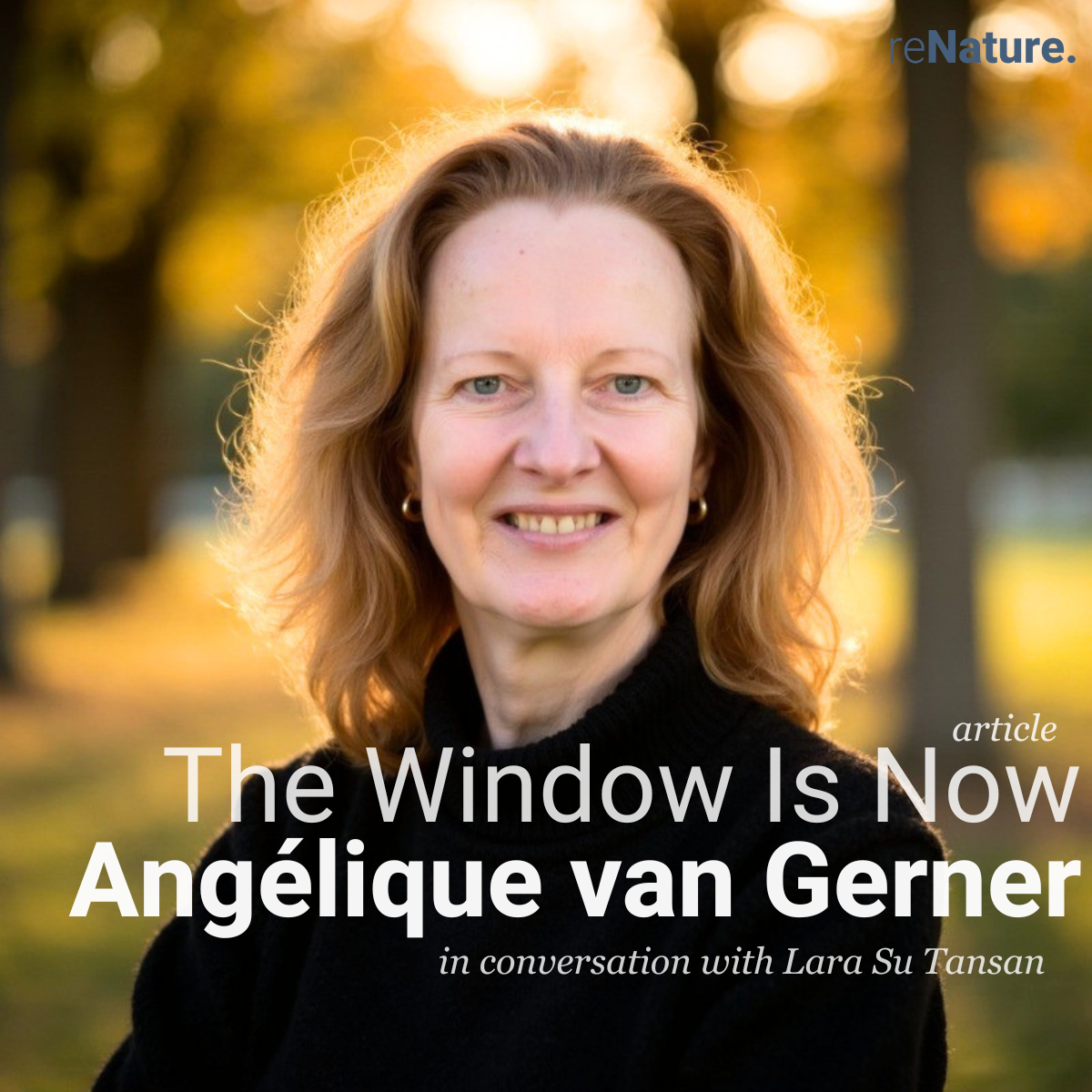
Angélique van Gerner is one of the clearest thinkers I’ve encountered on exactly that. And what struck me the most was that underneath all of her sophisticated financial logic, she believes. Quietly, stubbornly, with 25 years of evidence to the contrary, she believes that regeneration can feed the world.
Coming from a banker, that lands differently.
She was always going to end up here, just not the way you’d expect
Angélique spent 25 years in banking. Capital management, risk, strategy. Not the obvious path to founding a foundation dedicated to regenerating Spanish landscapes.
But after the great financial crisis, something cracked open. “I decided that where I work cannot be separate from who I am as a person,” she told me. “I can’t think in the weekend I buy all this organic food and then on Monday morning put off my coat and be this neutral banking person.”
That realisation led her to Triodos Bank, the most sustainable bank in Europe. She stayed 14 years. And it was there that two things happened that changed everything.
The first was Drawdown: a book by 80 scientists cataloguing every project in the world that could bring greenhouse gas emissions to an inflection point. She opened it and found that roughly half the projects had to do with our relationship to land.
“I thought: oh, okay. That’s a game changing aspect.”
And then the second thing: she looked at Triodos’s balance sheet and realised that this (the most sustainable bank in Europe) had only 4% of its assets in the agricultural sector. Not because they didn’t want to fund more. Because systemic impediments often make these projects impossible to finance.
“When I learned that about half of the Drawdown projects were about our relationship to land,” she said, “I realised that wasn’t even reflected in Europe’s most sustainable bank’s balance sheet.”
She sat with that. Then, quietly: “I have three daughters. They’re 23 and 18. I fear for the food security in Europe.”
That was the moment. A slow accumulation: the book, the balance sheet, her daughters, the desertification she was watching with her own eyes on her husband’s family land in Spain. At some point it stopped being something she thought about on weekends and became something she couldn’t not act on.
What RAAP! actually does
Angélique founded RAAP! (Regenerate-as-a-Project) a foundation focused on building scalable, investable finance models for regenerative agriculture. The work is currently centred on RegenerateSpain, built around La Junquera, a family farm in Spain’s Quípar Valley.
The ambition is deliberate and specific: create a repeatable finance structure for landscape regeneration that becomes the reference model for how to do this at scale. Not a pilot. A blueprint.
The model layers perennial crop revenues, a stewardship-based ownership structure, and blended finance: combining grants, debt, equity, and ecosystem services income in a way that works for the long timelines regenerative agriculture actually requires. In June 2025, RAAP! presented this model at Foodvalley’s Innovation Dialogue Series alongside Invest-NL, receiving concrete feedback from investors, banks, and intermediaries on how to sharpen and scale it.
She described the process of building the business case the way a scientist might describe an experiment: methodical, honest about uncertainty, clear eyed about what would need to be true for it to work. “I wanted to get a feeling for: is this worth my time? Is it gonna fly?” she said. “And for me, the answer was yes.”
Two broken models and one alternative
What makes Angélique’s thinking distinctive is that she doesn’t frame the regenerative transition as a farming problem. She frames it as a structural problem, one that requires replacing two dominant models that are both, in their different ways, failing.
The first is the traditional family farm. The average age of European farmers is 58. Their children have gone to university, moved to cities, and mostly aren’t coming back. “It’s a construct of the past,” she said, “to think that somebody needs to become a farmer just because their parents had land.” A vast amount of agricultural land will come up for sale in the next decade. The question is who gets it.
At reNature, we work with farming communities every day who are proof that transition from within is possible. But sitting across from Angelique, I found myself thinking about the structural reality she was describing. Because what she’s pointing to isn’t that farmers can’t change, but rather, the system around them makes it almost impossible to. And that part, I couldn’t argue with.
The second model is the investment fund: operating on 10 to 12 year horizons, measuring agricultural returns against everything else available. “If you can get a return in Bitcoin of 25%,” she said, with a kind of controlled frustration, “then suddenly that becomes the standard for what we need to do in agriculture. That’s insane.”
What she advocates for instead is land stewardship. Land leased long term to farmers who commit to working it regeneratively, through decoupling ownership from management, removing the pressure of short term returns that make transition almost impossible. The model exists already in parts of the Netherlands, France, and Germany. The challenge is scaling it.
“We need an alternative,” she said. “And our conviction is that land stewardship is that alternative.”
The governance piece nobody talks about
Individual farm transitions, Angélique is clear, are not enough. If you invest in one farm in Groningen and one in Limburg, you’ll never make a dent in the local water cycle, the biodiversity of a region, the resilience of a food system. You need farmers moving together across a landscape.
She described driving through the Spanish countryside with her husband’s family, with cousins who all own small plots of land, who gather at the exit of the church on Sundays to decide what they’ll plant next year. Beautiful in one sense. And also, she said gently, almost impossible to shift. The allegiance to the past, to how their fathers did it, to the agrochemical industry that has spent decades telling them there’s only one way, it runs very deep.
Her response isn’t to try to convince those farmers. It’s to focus on the land that’s coming up for sale and make sure it goes somewhere different. “There are loads of young people with a desire to farm who don’t have access to land and who would never be able to finance it,” she said. “Offer those people to lease land for a reasonable price, as long as they need to, working the soil in a regenerative way.”
On whether regeneration can actually feed the world
I asked her the question I always hesitate to ask because the answer is usually either evasive or naive: can regenerative agriculture actually feed the world?
She didn’t hesitate: Yes. But not with the current model of animal agriculture. Most of what we grow goes to feed animals kept in conditions that (if people saw them daily) would change behaviour faster than any policy. Shift to extensive animal husbandry, she said, and meat becomes more expensive. Which is fine. Because cover cropping and diverse regenerative systems can give us everything else we need. And it would mean we could stop destroying places like Brazil with intensive soy farming.
“We don’t need so much meat,” she said simply.
“I am convinced that humanity can save itself taking care of the earth.”
From a banker. After 25 years. After the balance sheet. After watching desertification spread across land her family has known for generations. After three daughters she worries about.
That’s a bet she’s made with her life.
On the business case question
I pushed Angélique on something that comes up constantly in reNature’s work: the insistence from investors that regenerative agriculture doesn’t have a strong enough business case. Her response was direct. The business case is visible to anyone willing to look. Sixty to seventy percent of European soil is already degraded, according to the EU’s own reports. The supply chains that global food companies depend on are built on land that is losing its capacity to produce. The real gap isn’t the business case. It’s the financial architecture to capture it.
What she sees as most promising: pairing perennial crop revenues with ecosystem services income, tiered blended finance that phases capital needs over time, and governance structures that allow non-traditional investors like water boards to participate based on specific measurable outcomes.
“If farmers feel the transition is too costly,” she said, “they’re getting bad information. It’s an educational gap.”
Why the window is now
Angélique is not an optimist by temperament. She is a systems thinker by training, which means she sees clearly how deep the structural problems run. But she is also, quietly, certain.
The next ten years will determine who gets the land that’s coming up for sale across Europe. It will determine whether the financial architecture for regenerative transition gets built now, while there’s still time, or gets delayed until the window closes. It will determine whether the 4% becomes 40%, or stays exactly where it is.
“I am convinced that humanity can save itself taking care of the earth,” she said.
Thank you, Angélique, for your time, your thinking, and for the quiet urgency you brought to this conversation.
If you haven’t heard about RAAP! and RegenerateSpain, start there.
Lara Su Tansan, Content & Consultant @ reNatureIn conversation with Angélique van Gerner, Founder of RAAP! (Regenerate-as-a-Project)
We use cookies and other tracking technologies to improve your browsing experience on our site, show personalized content and targeted ads, analyze site traffic, and understand where our audiences come from. To learn more or opt-out, read our Cookie Policy. Please also read our Privacy Notice and Terms of Use, which became effective December 20, 2019.
By choosing I Accept, you consent to our use of cookies and other tracking technologies.