

Meet the Farm of the Future and Afua Pokuaa
The Farm of the Future (FoF) is a regenerative agroforestry project based right here, in Meduma, Ghana, in the Nsokote district! It is led by reNature together with a consortium of partners: Beyond Beans, Carboneers, SPAAK, Maxim Nyansa, Groasis, and TheRockGroup, and funded by RVO, which is the Netherlands Enterprise Agency.
We started this project in December 2024 and will run it through December 2028.
The project works by transforming a real, working cocoa farm into a demonstration site (also called by us as “Model Farm”) for regenerative farming. A Model Farm that neighbouring farmers, youth, and communities can visit, learn from, and replicate on their own land. It combines agroforestry design, digital tools, biochar production, financial literacy, and community training into one integrated model. Because we believe that the community can build each other up and create a better cocoa future.
We are working towards creating a blueprint for how cocoa farming across Ghana can become more productive, more resilient to climate change, and more economically viable. Not only for this generation, but also for the next.
Why?
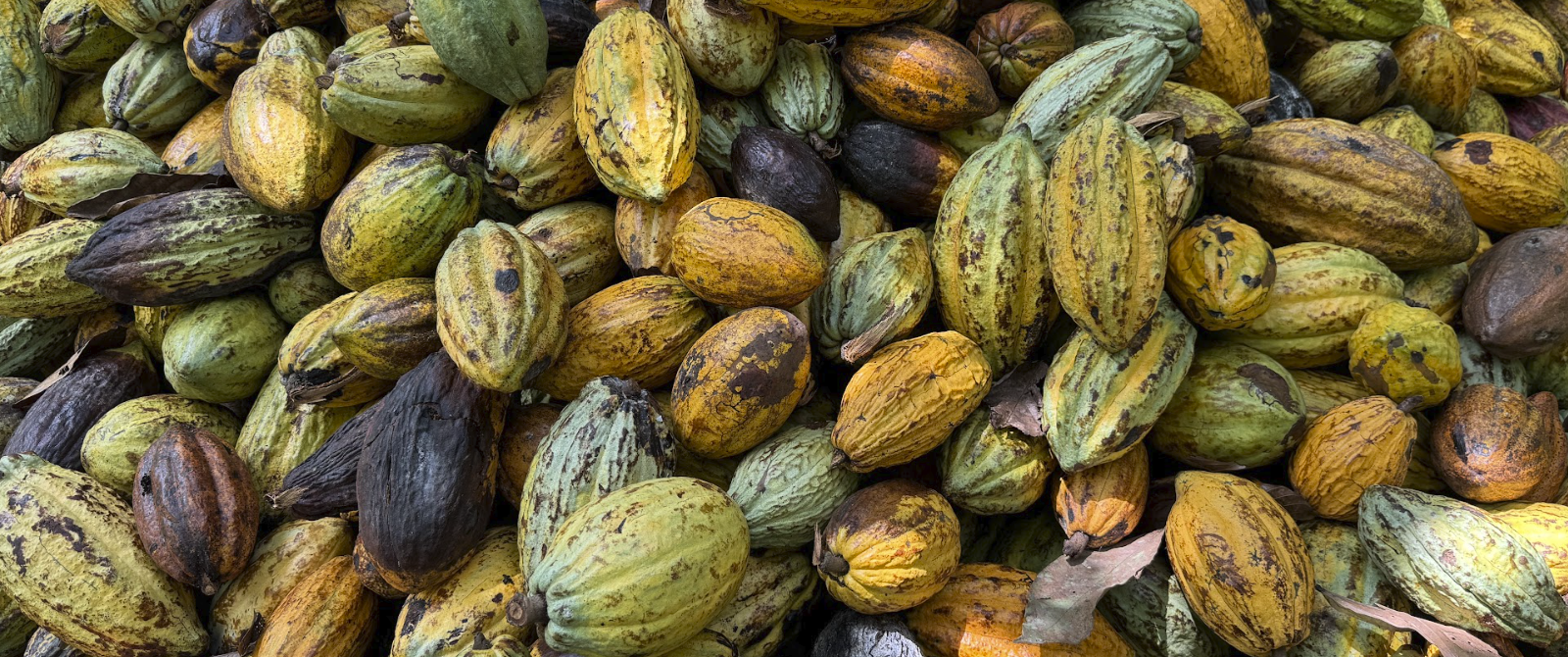
Ghana’s cocoa farmers are caught in a crisis. Yields have dropped by up to 50% in recent years. Soils are exhausted. The trees are old (on Afua’s farm alone, over 50% of cocoa trees were already underproducing when the project started).
Chemical fertilizers are increasingly expensive, yet have become increasingly necessary due to a cycle of dependence. The Nsokote district, where we are currently, faces irregular rainfall, Harmattan winds, and growing climate unpredictability. And younger generations are beginning to leave rural farming communities behind.
Project Goals
The project has 4 concrete goals:
- Restore farm productivity: Through regenerative agroforestry, farmers move away from a single cocoa income toward a diversified farm economy, resulting in higher cocoa yields, fruit tree harvests, annual food crops, carbon credit revenues, and reduced fertilizer costs. Yield increases are projected at 2% by 2026 and up to 42% by 2036 as the perennial trees mature.
- Regenerate the land: The agroforestry system improves soil organic matter, reduces erosion, increases native species diversity by 30%, and creates a microclimate that buffers cocoa against heat and drought, with 50% less pesticide and 30% less synthetic fertilizer use targeted by 2028!
- Build knowledge and digital skills: Transitions does not change many things if they are not done with the future in mind, so a Learning Center will train 20-30 farmers per year in digitalisation and digital tools, farm management, as well as financial literacy. 25 young people will be engaged in the production of biochar and digital monitoring, which is becoming increasingly important for the future. The goal is to make farming feel worth staying for.
- Create a replicable model: Nothing tested here stays here. Every practice, result, and lesson is designed to transfer to surrounding farmers and communities.

The Model Farm Role
This 4 hectare farm in Meduma belongs to Afua Pokuaa, a farmer who has managed this land for decades. It was selected as the model farm because it reflects what most cocoa farms in the Nsokote district look like: aging trees, compacted soils, erosion prone patches, and a growing dependency on external inputs.
The transformation here (new tree species, restructured shade systems, intercropped food plants, biochar soil treatment, and digital monitoring) is designed to be seen. Neighbouring farmers, youth groups, labour groups, and visiting field officers come here to see the changes in practice, not just on paper. Afua herself participated directly in designing the new layout! Together, we have built her own vision for her farm.
Farmer Outreach
The project works outward through labour groups, training sessions, and farmer to farmer knowledge transfer. The aim is to reach 100 farmers in nearby communities during the first phase, expanding to 200 farmers by 2028, each implementing agroforestry on their own land with the support of trained field officers and digital tools.
Scaling Ambition
By December 2028, the project targets:
- 200 farmers implementing agroforestry
- 200 hectares under improved management
- At least 10% increase in household income per farmer
- 25 young people trained and employed in digital and biochar work
- A fully operational Learning Centre and Centre of Excellence built to sustain and replicate the model long after the project ends
