

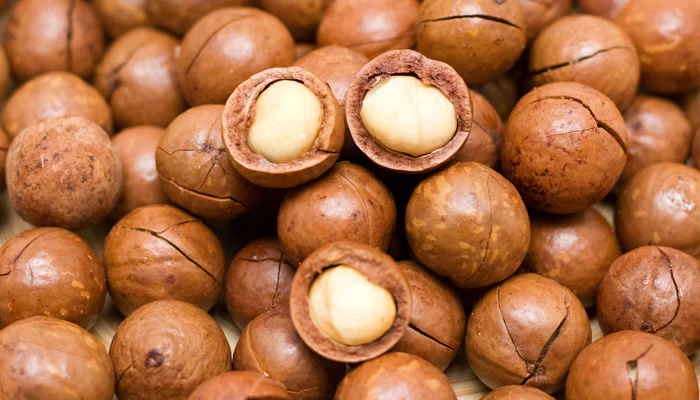
Macadamia
The Butchulla people of Queensland were the first to harvest and trade macadamia nuts, so early on, that the macadamia tree’s ancestors were thriving in the region 50 million years ago, according to fossilized pollen found in central Queensland. Macadamia farming began in the 1870s at Rous Mill near Lismore, but early efforts failed due to limited knowledge, native pests, and fire. In the 1920s, Hawaiians commercialized the industry using wild seeds from Queensland, developing cultivars that dominated global production until the 1980s. Today, Australia is one of the world’s top macadamia producers.
However, the conventional macadamia farming that predominantly takes place not only in Australia but also in South Africa and Kenya has often relied on monoculture, leading to soil degradation and high water consumption. Just as much as being valuable to the food industry, with its expected market size expected to reach 2.8 billion euros (2.99 billion USD) in 2030 , macadamia trees are a valuable addition to agroforestry systems.

Macadamia trees’ deep root systems improve soil stability, and when intercropped with nitrogen fixing species such as Acacia and Calliandra, they enhance soil fertility and water retention. Thus, macadamia trees prove that beyond their economic value, they hold immense potential for sustainable farming when cultivated in diverse, regenerative systems rather than monocultures, which is what we focus on as reNature, to ensure more and better yields.


