


Meet Our Local Expert: Fred Marani, Kenya
Published on: February 19, 2026
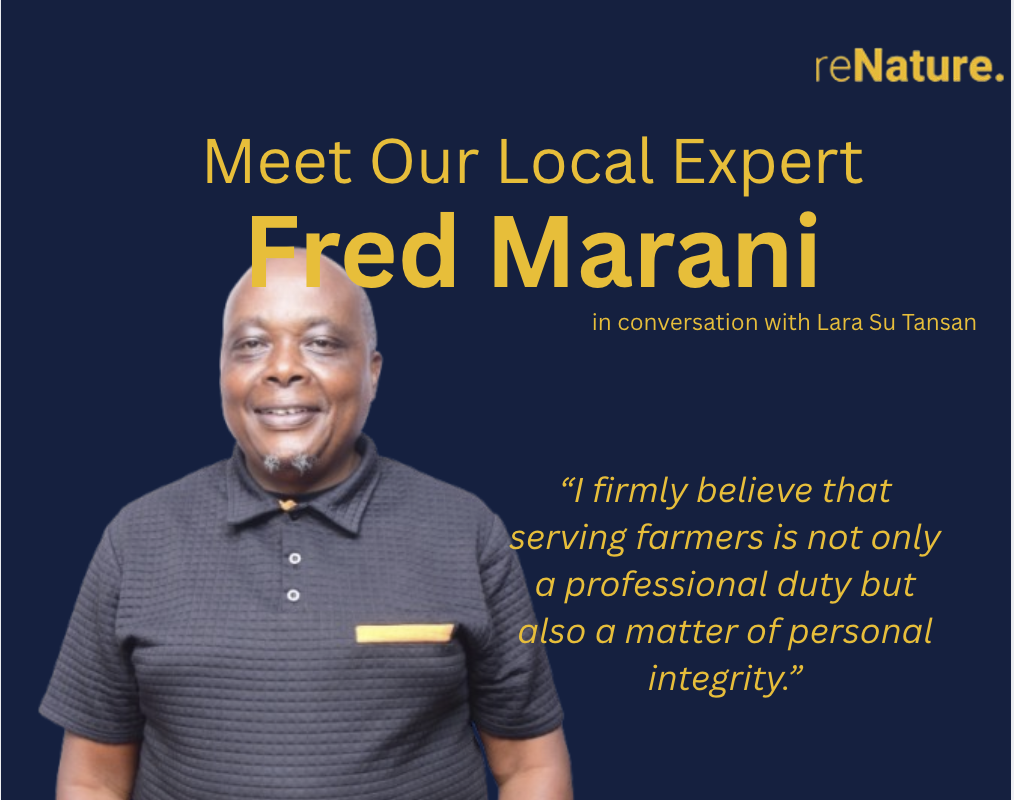
What sets reNature apart for me is that in a sector full of organisations that design from the top down, reNature’s starting point is local knowledge. For us, regenerative agriculture begins with people: people who carry knowledge in their hands, who understand farming communities from the inside, and who refuse to do anything halfway.
Fred Marani is one of those people.
Fred has spent over two decades working directly with smallholder farming families across Kenya. He is technically sharp, deeply experienced, and quietly principled in a way that I find rare. Fred approaches his work as a matter of personal integrity. Farmers, he believes, always know whether they are being well served, and he has built his entire career around making sure the answer is yes.
This is Fred’s story, told largely in his own words.
Born into farming, pulled toward purpose
“I was brought up in a subsistence agricultural family. After school, on weekends, during holidays – I was helping tend the cattle and weed the crops. It felt completely normal, because everyone at home was doing it happily.”
Fred grew up in Western Kenya in a household where farming was simply life. There was no massive awakening, no single mentor, no pivotal moment of choice. Agriculture was the texture of his childhood, and he absorbed it fully.
What followed was a methodical, deeply committed education in how to serve that world better. Fred became the top student in agriculture at secondary school. He trained as an agriculture extension advisor at a government college. He pursued an undergraduate degree in development studies with a focus on sustainable development, and later completed a postgraduate degree in public policy. Each step, he says, pointed back toward the same thing: finding ways to genuinely support farming families in building more resilient, more dignified lives.
Today, he is based in Kisumu, on the shores of Lake Victoria, and works with smallholder mixed farming families (households raising both crops and livestock) within the Lake Victoria Basin. He brings to this work more than 20 years of hands on agroforestry and regenerative agriculture extension experience.
Mount Elgon and a lesson in integrity
Early in his career, Fred was posted to a remote area on the slopes of Mount Elgon in Uganda by an international NGO. It was his first assignment as a Community Agroforestry Extension Officer, and the conditions were not easy :remote terrain, limited resources, a community still learning to trust.
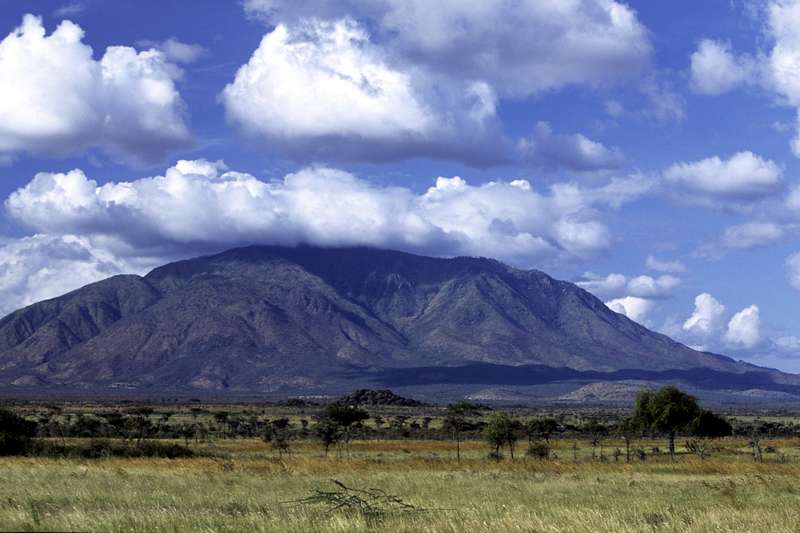
Around this time, Fred overheard something that changed him.
“I was staying in the same town as a more experienced colleague who worked in a neighbouring area. I overheard farmers expressing dissatisfaction with her work because they felt she hadn’t made a visible difference in their lives. I took that as a direct challenge. Not to her, but to myself.”
He threw himself into his work. He trained farmers in agroforestry and regenerative practices and five years later, he was promoted to Zonal Manager, a reward for exactly the kind of impact he had been striving toward.
“When I left for the new role, the farmers protested. They didn’t want me to go. What they didn’t know was that the promotion was the recognition for the very work they were acknowledging.”
It’s a story Fred tells quietly. But it captures something essential about who he is: someone for whom the distance between doing a job and doing it well is simply not acceptable.
“Farmers always know whether they are being well served,” he says. “And serving them is not only a professional duty. It is a matter of personal integrity.”
Why conventional farming was failing and what needed to change
Fred’s first posting as an extension officer was in Trans Nzoia County, one of Kenya’s most agriculturally productive regions, sometimes called the country’s “food basket.”
“Farmers were relying heavily on chemical fertilisers, mechanisation, intensive tilling. Forests were being cleared. Crop residues were burned. Maize was everywhere and almost nothing else.”
The consequences accumulated quietly at first, but then, things became severe: soil erosion, declining soil fertility, forest degradation. And a particularly painful detail: women in the community, who could no longer access firewood easily, were burning maize stalks to cook meals. The very resource the land had produced was being destroyed to survive because the land had been so depleted it could no longer sustain its own cycles.
Yields shrank. Families were running out of food before the year was half over. External inputs became more expensive, not less. Poverty tightened its hold on communities that had once fed themselves abundantly.
“I learned from older farmers that Trans Nzoia was once extraordinarily fertile. You didn’t need external inputs. The land gave you what you needed. That started to change around the 1970s, as forests disappeared and intensive farming took over.”
This context gave Fred’s work as an agroforestry extension officer its urgency. Reintroducing trees onto farms. Rebuilding soil health through organic matter. Restoring what had been systematically dismantled.
“The only realistic option,” he says simply, “was to translate theory, policy, and decisions into tangible action.”
The power of seeing with your own eyes
One of the most effective tools Fred has developed over the years is a moment of honest confrontation, which I take a lot of inspiration from.
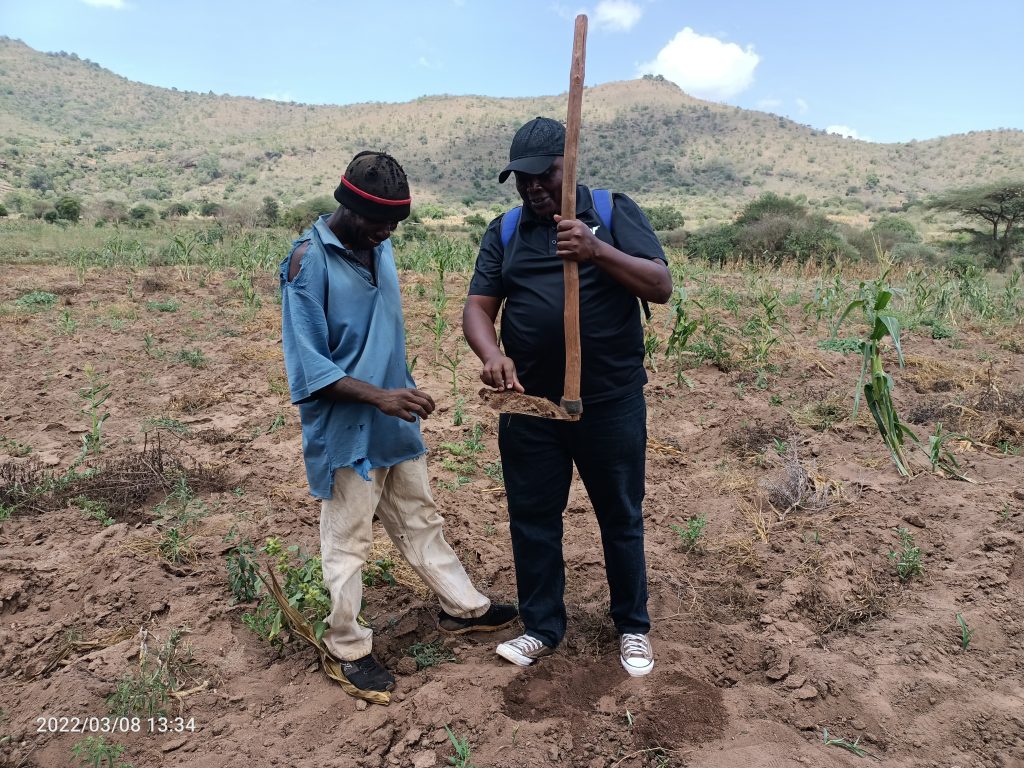
During soil health assessments, Fred guides farmers through a practical, hands on process of evaluating their own land. The results are often shocking, and not because Fred tells them the soil is degraded, but because they see it themselves.
“Farmers were taken aback by the extent of degradation they observed in their own soil. That realisation of arriving at that understanding through their own eyes and hands was a far more powerful motivator than anything I could say.”
This insight has shaped how Fred approaches extension work more broadly. Rather than arriving with answers, he creates conditions in which communities discover the problem, and the possibility, for themselves. Contextual analysis using visual, locally comprehensible tools leads to what he calls “profound self discovery”, and self discovery, in his experience, leads to action.
Work with reNature: projects across Kenya
Between 2022 and 2023, Fred worked across a range of reNature projects in Kenya, each demanding a different kind of engagement with landscape, community, and crop systems.
He supported Agriterra affiliated coffee cooperatives in transitioning to low carbon coffee production through regenerative agroforestry which consisted of working with farmers, cooperative leaders, county government representatives, the Kenya Coffee Research Organisation, and the Kenya Forestry Research Institute to shift practices on the ground. A parallel assignment with Sucafina deepened this work, integrating agroforestry into coffee farms connected to affiliated cooperatives.
In Homa Bay County, he supported Wable in a project focused on regenerative agriculture for sustainable water management, addressing the kind of landscape level water vulnerability that communities in the Lake Victoria Basin know intimately.
Further south, in Voi in Taita Taveta County, Fred worked with Labl Fashions to establish a regenerative cotton model farm, a living learning site where farmers could observe, question, and replicate the practices in their own fields.
He also supported Finlays and Yogi Tea in integrating regenerative farming practices into the production of botanical herbs, including peppermint and lemongrass, bringing a regenerative lens to a supply chain that reaches global consumers.
“The model farms we established are operational. Learning is happening. That is what matters.”
What works and what is hard
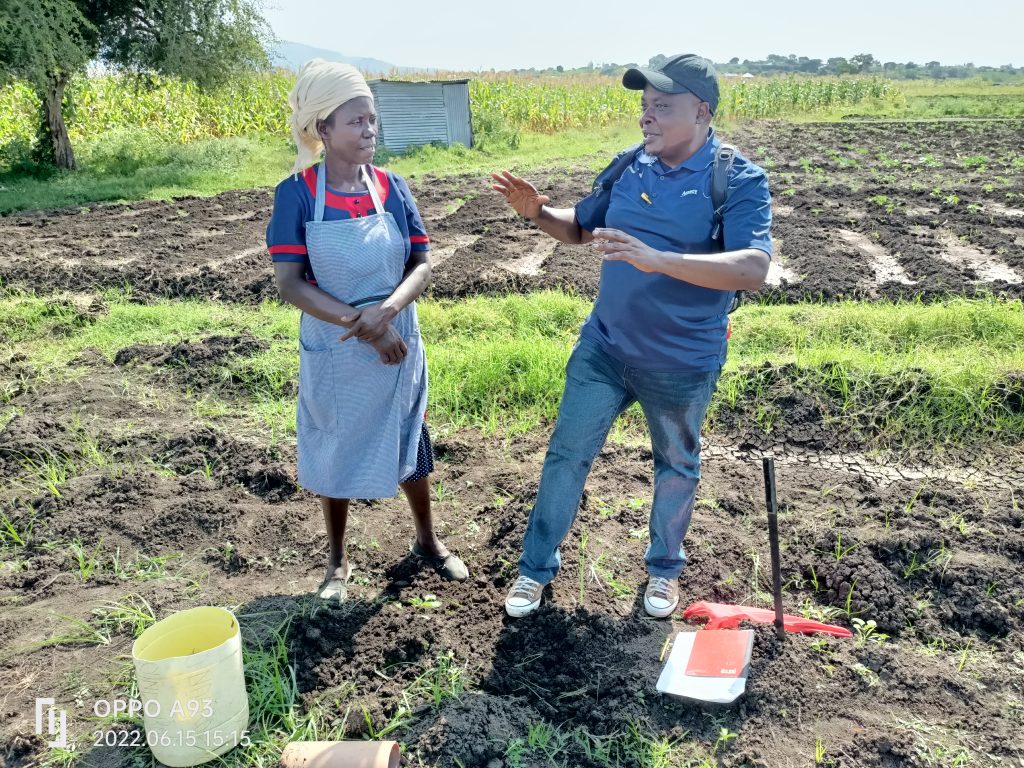
In Fred’s experience, the early years of a regenerative transition are marked by one thing above all else: immense farmer interest.
“The demand for learning sites was always higher than what we could support. Farmers wanted to see model farms in their own landscapes, not just hear about them. They were ready.”
That hunger, he says, is one of the most encouraging things he has witnessed in this work. It means the need exists, and the willingness is there. What regenerative transitions often lack is not farmer motivation but it is resources: enough model farms, enough monitoring, enough time.
“There was always a need for extended monitoring. Transitions do not happen in a single season. You need to stay close.”
The questions he most often receives relate to agroforestry species: which trees are suitable for a given landscape, how to manage them, where to source seeds and seedlings. These are practical, granular concerns, and Fred takes them seriously. Even after his direct on the ground engagement on specific projects ended, he continued providing advisory support whenever contacted.
A lesson learned the hard way
The most memorable lesson Fred describes involves not a failure, but a revelation, experienced by farmers, not by him.
“When you use contextual analysis tools that farmers can see and touch and interpret themselves (soil assessments, visual landscape mapping) something shifts. They stop waiting for an expert to tell them what is wrong. They see it. And seeing it themselves changes what they are willing to do about it.”
This is, for Fred, a philosophy of extension work: the most durable change comes not from the advisor’s knowledge, but from the community’s own awakening to what their land is telling them.
What reNature gave Fred, and what Fred gave back
Fred speaks about his time working with reNature with genuine warmth.
“reNature gave me the opportunity to share my experience across diverse landscapes in Kenya ,different ecosystems, different communities, different cultures. That broadened how I think about regenerative agriculture, and where it can go.”
He describes refining his skills in contextual analysis through the reNature approach, encountering new frameworks for understanding how local context shapes what interventions are possible and appropriate. The exchange was mutual: he brought decades of on the ground knowledge; reNature brought new lenses for applying it.
“I learned a lot from reNature, especially on the contextual analysis approach. And I hope what I brought was useful in return.”
Why this work still matters and why Fred keeps going
After more than two decades, Fred’s motivation remains as clear as it was when he overheard those farmers on the slopes of Mount Elgon and decided to prove something, not to anyone else, but to himself.
“I keep going because of the testimonies. Farmers who started with limited resources and have since achieved real change: more food security, more diverse income, better lives. When I hear those stories, everything makes sense.”
He is, at his core, a believer. Not in systems or frameworks or carbon credits but rather, in the specific possibility that farming families, given the right support and the right knowledge, can build something lasting. Regenerative agriculture, for Fred, is not an ideology. It is a practical path out of the degradation and poverty that conventional systems have created, and toward something that actually works, for people and for land.
“I am firmly convinced that regenerative agriculture is a viable solution to food and income insecurity, environmental degradation, deforestation, and climate change. That conviction has never wavered.”
Why Fred inspires me
Fred inspires me because of his integrity. The kind of integrity that makes farmers protest when you leave, because they know how rare it is to be truly served.
He has no illusions about the difficulty of this work. He knows the land can be stubborn, that transitions take time, that resources are never enough. But he has spent his entire career showing up anyway, in remote postings, in smallholder fields, in soil assessments that change how farmers see their own land.
That is what local expertise looks like. And that is why Fred Marani is such a vital part of what reNature does.
