

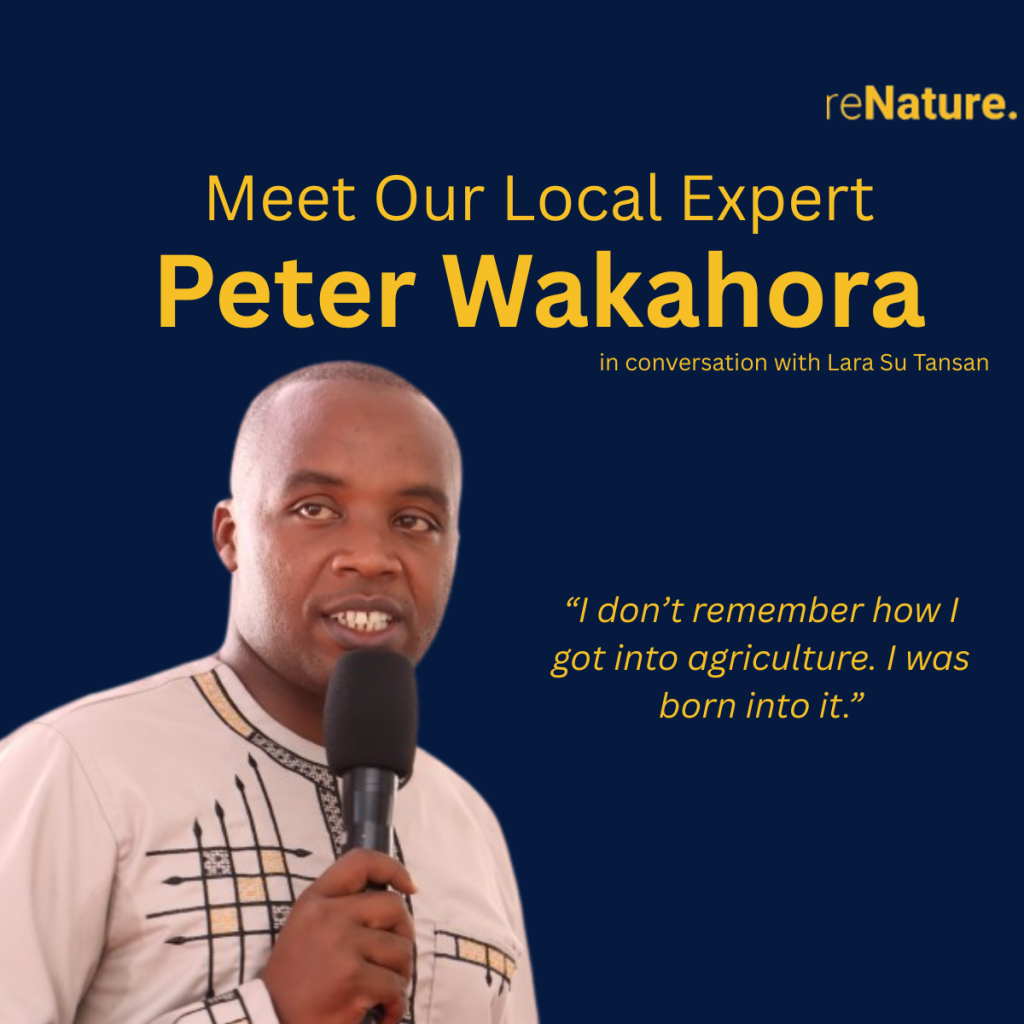
Meet Our Local Expert, Peter Wakahora
Published on: January 19, 2026
At reNature, regenerative agriculture does not begin with a design on paper. It begins with people who know the land intimately, who understand communities from the inside, and who are willing to stay when the work is slow, difficult, and uncertain.
This is why working with Peter Wakahora has been so meaningful for me.
Peter is deeply knowledgeable, but never abstract. He is technically sharp, yet profoundly human. He listens carefully, learns constantly, and designs with care. What stands out most is how seriously he takes responsibility, toward land, toward people, and toward the long term consequences of every decision. He is someone who is truly on top of his work, by understanding systems deeply.
This is Peter’s story, told largely in his own words.
Born into agriculture and shaped by its contradictions
“I don’t remember how I got into agriculture. I was born into it.”
Peter grew up in central Kenya, at the foot of the Aberdare Ranges, in a small-scale mixed farming household. Agriculture was not a profession; it was daily life. His family kept two cows, several sheep, and dozens of chickens. They cultivated around half a hectare of maize, beans, vegetables, and herbs for household use. Another one and a half hectares were dedicated to what they called “cash crops” coffee and tea grown mainly for export. Near the riverbed, a small forest supported arrowroot production.
“This background prepared me for agriculture,” Peter reflects, “but it also created bad memories.”
Farming demanded long hours of hard physical labour, and despite the effort, his parents earned very little. As a child, Peter watched them work relentlessly while struggling to make ends meet. At times, farming felt like forced labour rather than a livelihood with dignity. Those early contradictions (abundance and scarcity, effort and low reward) stayed with him.
Environmental science and the first professional steps
Peter initially applied to study law, but instead entered university through his second choice program: Environmental Science. That turn proved decisive.
“At university, I was introduced to concepts like sustainable development,” he says. “I began to understand how agriculture impacts and is impacted by the environment and human systems.”
His first professional role was closely aligned with this understanding. He worked on finding ways for farmers to generate income on their land so they would not overdepend on nearby forest resources. This became his first formal bridge into agriculture as a profession.
Agroforestry emerged naturally. Avocado, mango, and macadamia were introduced as fruit trees. Grevillea was selected as a fast-growing agroforestry tree for firewood, managed through annual pruning. Minimal tillage practices were introduced, alongside composting, agricultural waste management, and the use of animal manure to enrich soils.
These were not abstract sustainability measures. They were practical responses to real pressures faced by farmers.
A moment in the field that changed everything
One experience in Laikipia profoundly reshaped how Peter understood farming and land.
He witnessed farmers being encouraged, even pressured, by tractor operators to burn maize stalks to make farming “easy” and fields look “clean.” One fire grew too strong and spread to a neighbouring farm, causing significant loss.
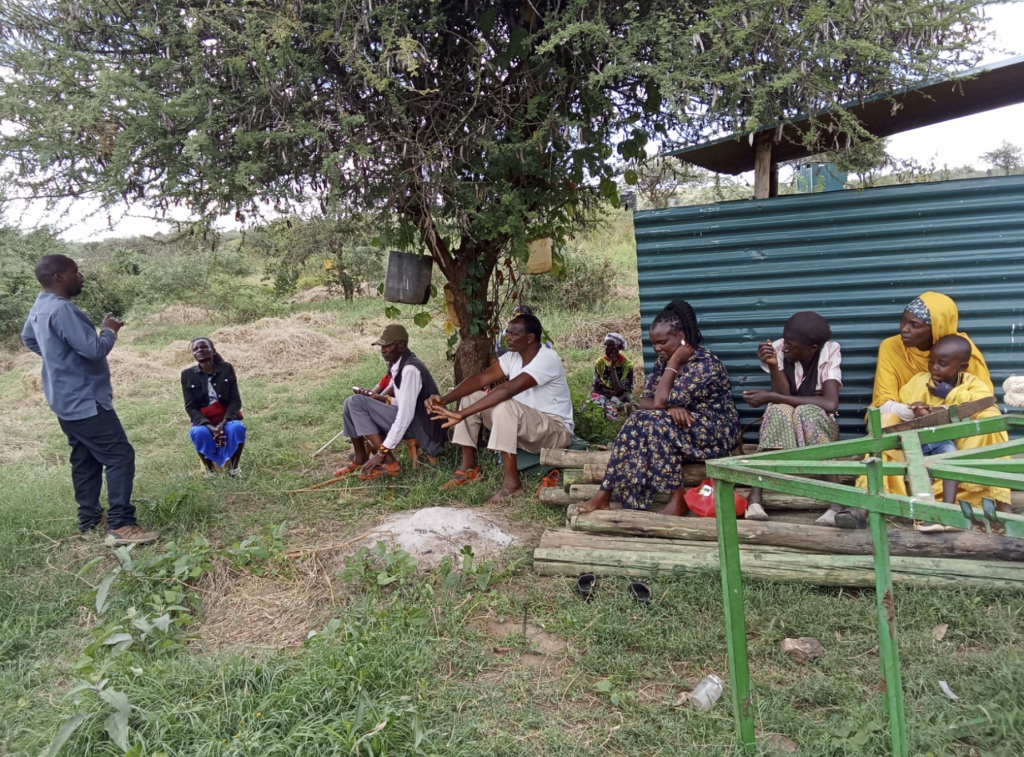
As the community came together to support the affected families, Peter realised how deeply the idea of the “clean farm” was ingrained, and how destructive it could be.
“Nature does not expect fine and clean farms,” he explained to the community. “Agricultural remains are part of the farm. Destroying them means destroying the very nutrients we later buy expensively.”
He took time to guide farmers back to older ways of thinking, how their ancestors managed land without harming nature. The discussion led to a collective decision to try a different approach: using nature itself to solve challenges.
Farmers began focusing on permanent soil cover, crop diversity, reduced tillage, and mimicking natural systems – allowing multilayered use of space, just like the nearby forest. The outcomes were striking: increased food supply, improved nutritional diversity, better energy efficiency, and noticeably improved relationships within the community.
Germany, urban food systems, and the clarity of regeneration
Peter’s understanding of regenerative agriculture became clearer during postgraduate studies in environmental management in Germany, just before COVID-19. “While I knew many of these ideas already, just under different names – that’s when everything came together.”
What struck him most was the logic of working with nature rather than against it. Agriculture, he realised, does not revolve around humans alone. Soil, water, plants, animals, and microbes all matter. He was particularly intrigued by the central role of soil protection (mulching, cover cropping, and organic matter) and how quickly soil health could respond. Integrating livestock into cropping systems also took on new clarity. While livestock had always been part of Kenyan agriculture, the regenerative logic behind integration had not been well articulated before.
Crop diversity stood out as well – not just for resilience, but for pest management, as plants protect one another by breaking pest cycles.
Perhaps most inspiring was seeing communities produce food even in limited urban spaces, freeing themselves from chemical dependence and seasonal traps that determine what people eat.
“That’s when the regenerative agriculture seed was planted in me,” Peter says.
Applying regeneration with reNature: model farms and real outcomes
With reNature, Peter has worked across Laikipia, the Rift Valley, and beyond, supporting smallholder farmers (many of them pastoralists) in transitioning toward regenerative systems.
At the Laikipia Permaculture Centre, supported by LB Foundation, Peter trained 569 households in regenerative fruit and vegetable production. Together, they established a Model Farm on the centre’s grounds, designed as a hands on learning space.
Scaling up further with Lekiji and Endana, supported by ADM, Peter trained and worked directly with 117 community members. Two additional Model Farms were implemented (one in Lekiji and one in Endana) with 23 replications across the surrounding communities.
In just nine months, these farms produced over 1,000 kilograms of vegetables, reaching 350 indirect beneficiaries.
Peter also contributed to regenerative tea system design in Kericho County, working with Finlays and Yogi Tea, integrating crops like peppermint and lemongrass into regenerative production systems for both large- and small-scale farmers.
One moment remains deeply personal for Peter: a woman in her mid 50s selling vegetables for the first time in her life. “She told me she had never sold any type of food before,” he recalls. “That’s when regeneration becomes real.”
Day to day work: learning, adapting, staying close
Peter’s daily work goes far beyond training in the conventional sense.
“Training doesn’t mean telling people what to do,” he explains. “It means learning together.”
He co-designs solutions with communities, adapting plans as realities emerge. In one case, a fruit tree included in the design failed due to a naturally occurring bacterium in the soil. The response was not frustration, but learning.
Communities experiment with natural pesticides and repellents made from local vegetation, practice seed saving to protect genetic diversity from erosion by multinational seed systems, and draw actively on traditional knowledge.
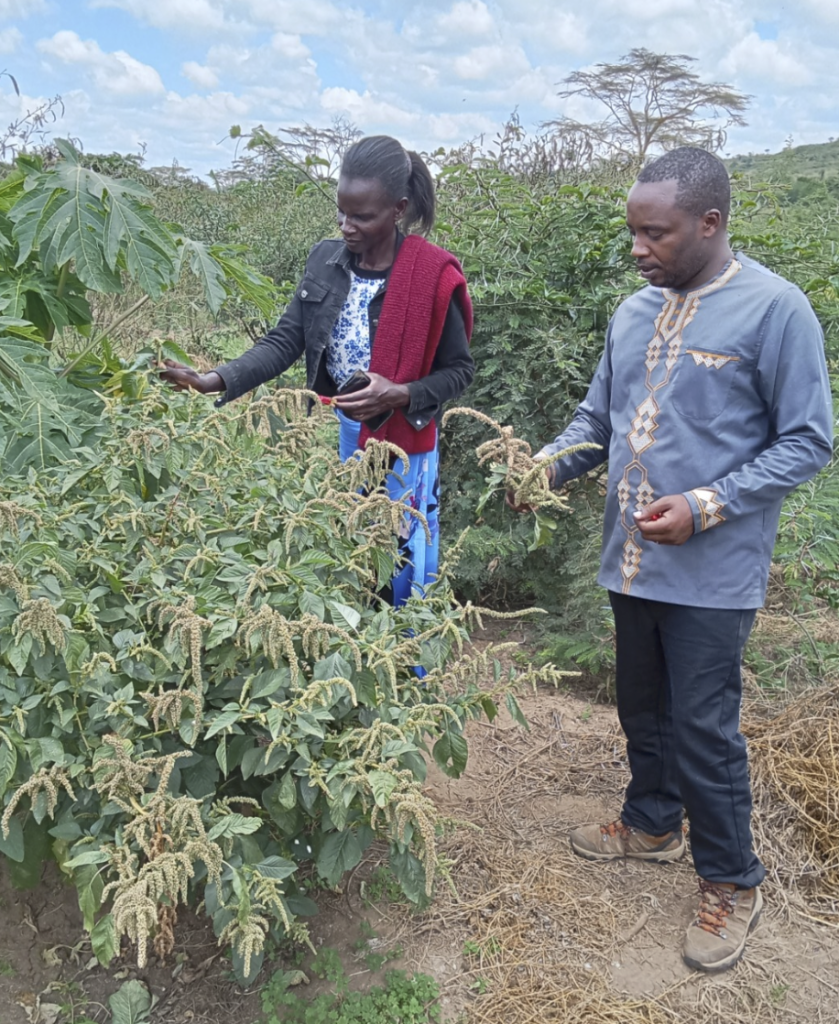
Monitoring is constant. Every two weeks, Peter visits model farms, listening to concerns, frustrations, and lessons learned. Participatory tools like How Might We? help communities identify challenges and opportunities together.
He is particularly energized when communities revive traditional practices (using wood ash, pepper, or even elephant dung to deter pests) blending ancestral knowledge with observation and experimentation.
Peter also supports market access. At one model farm in Lekiji, he negotiated an offtake agreement with a local ranch: 20 kilograms of vegetables every two days, paid monthly. The ranch also agreed to return kitchen waste to the farm, closing nutrient loops. He advises farmers on planting schedules to ensure consistent production and avoid losing markets.
What works and what is hard
What works best, Peter explains, is collective vision. Participatory mapping helps farmers identify assets already present in their landscape. The idea of a “desired future” creates hope early on.
The model farm approach is especially powerful. Learning by doing reveals abilities and competencies that daily hardship often hides. Peter observed improved mental well-being, particularly among women. In one case, elderly community members volunteered at the model farm to care for children while mothers worked – a quiet but powerful expression of social regeneration.
Access to diverse crops was transformative. Spinach, zucchini, and passion fruit (once considered foods “for the rich”) became part of daily diets. Communities moved from scarcity to surplus and began organizing markets.
What was genuinely difficult was taking the first step. Degraded land was ruthless. Topsoil was gone, rocks protruded everywhere, and drought made progress uncertain. Earthworks were physically exhausting. In response, Peter introduced a temporary food for work system, compensating participants during the most difficult phase through mobile money transfers. This support was gradually phased out as rains returned and vegetables grew.
For farmers accustomed to chemical inputs, trusting a system without them was another major challenge.
“They were used to quick and effective solutions,” Peter says. “One pump, all pests gone.”
Regenerative systems demanded patience, repetition, and trust: qualities that take time to build.
Hard earned lessons and lasting motivation
Peter learned that nature reciprocates good action. Simple earthworks like bioswales slowed, spread, and sank water. After short rains, moisture remained in the soil long enough for crops to grow. He also learned that regenerative agriculture requires persistence. Organic pest control works but only with continuous application. There are no shortcuts. One of the most meaningful moments came when a rocky, degraded piece of land was transformed into a productive space in just 90 days. When disagreements arose about how to share the harvest, Peter called it a “good conflict.” “At least there was something to share,” he says. That day, 400 spinach plants were distributed to 15 households – the first step in replication.
Another unforgettable moment was hosting visiting students from Oxford through Mpala Research. Community members led the farm tour themselves, sharing their story in their own words. The students stood in the hot Laikipia sun for two hours, visibly moved.
Why Peter inspires me
Peter inspires me because he combines depth of knowledge with humility, care, and accountability. He does not impose solutions. He builds them with people. He respects traditional knowledge while strengthening it with structure and science. And he never loses sight of the fact that regeneration is ultimately about people: their dignity, agency, and future.This is what local expertise looks like.
And this is why Peter Wakahora is such a cornerstone of our work at reNature.
